
Plot Twist
Wine Travel Beyond the Socials

This week I’m going to close out my in-depth series on Rioja. I’m sure, however, you’ll see this Spanish region, with which I’m forever intertangled, grace my glass and appear in future issues. But first, let’s dip into a few non-Rioja pours that satiated my wine-loving self these past few weeks.
In My Glass
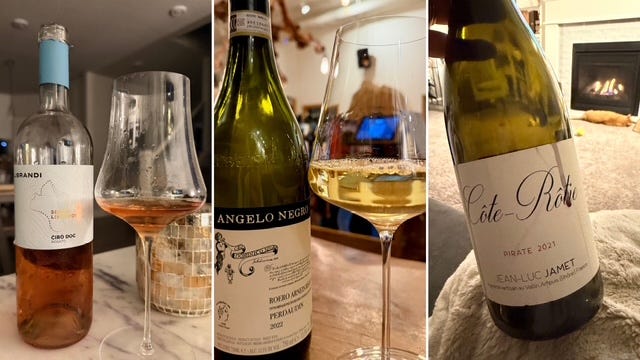
2024 Segno Librandi Cirò DOC Rosato
This pink pour is definitively Italian and it has something to say. It’s not shy or the slightest bit subtle either. It’s sassy, in your face, and most certainly will have you standing at attention. From the Calabria region of Southern Italy, this rosato from the native grape Gaglioppo is deeply salmon-colored with assertive aromas of red fruits and herbs. It was both intense and robust enough to stand up to a variety of flavorful sushi maki with its bold notes of pomegranate, strawberry, and zesty blood orange, not to mention its engaging texture. I’m pretty sure if this wine had a persona, it would be the one starting the post-Vinitaly bash at the gas station - the one that starts with wine, cigarettes, and local songs, and devolves (or evolves) into dancing, debauchery, and credit card sabering of an untold number of bottles of metodo classico. It’s ubiquitously unboring. Fuck. (or Kiss depending on your penchant or lack-there-of for profanity) $18
2022 Angelo Negro Perdaudin Roero Arneis Riserva
Alright, after that adrenaline-junkie of a wine that will leave you breathless after its memorable goodbye (chef’s) kiss, let’s slow things down to a more subtle, romantic, yet equally enticing cascade of flavors and complexity. This dry and exotic white wine will charm with a soft, silky finesse. A wine often recognized for its delicate yet warming floral aromas and unctuous orchard fruit flavors, this expression takes a refreshing tropical turn with hints of pineapple, laced with a clean minerality. It’s smart and calming, and leaves a lasting impression. Marry. $29
2021 Jean-Luc Jamet Côte Rôtie “Pirate”
I’m gunna start off by saying, I did not pay the current retail price of this wine when I bought it last year. Pretty sure I shelled out around $75. I guess this is one of those wines that appreciates in value? Well, based on our ignorant enjoyment, for good reason. It’s a limited production Syrah from a prestigious lieu-dit* and frankly, it rocks. If you’re a fan of that dirty, mineral, earthy Syrah synonymous with the Northern Rhône - think meaty, olive tapenade, grilled herbs, and white pepper, with a core of red fruit - this is one to snag and lay down. It’s a punchy juvenile atm, dense and concentrated, but it’s marked for future success and reward. Granted, picking it up now may be something of a FOMO buy. So maybe… Kill? (or just plan to kill the bottle at some point in the future - your call) $200
Plot twist! I know I said this week’s pours were non-Rioja, but after that last bottle, I thought I’d share a few more reasonably priced bevies that deliver quality and deliciousness without causing anyone to raise an eyebrow at your cc statement. White Rioja. It’s a thing. And it’s not all oxidative, aged, and pricey. The category is trending and this Muga demonstrates why. It’s clean, crisp, has a popping acidity, and a range of aromas and flavors, making it anything but simple and forgettable. If you see this on a btg list, don’t hesitate. In fact, at this price point, it’s likely to be one that the bartender wittingly over pours (past the 5 oz mark), and for that you’ll be grateful. Fill‘er up. $20


2018 Conde Valdemar Rioja Crianza
It’s hard to beat a Crianza on price and quality. Seriously, Rioja is basically the Napa equivalent of Spain - well-marketed, sold and recognized worldwide, and yet many of the region’s second-tier labels are not only palatably priced, they’re also unequivocally palatable. Okay, maybe not every single one, but I’ve yet to be disappointed by anything Bodegas Valdemar produces - and that goes for their Valdemar Estate in Walla Walla, Washington as well. So yes, you could elevate your Tuesday night by inadvertently pouring a $200 wine, or you could knowingly crack open this affordable Crianza for a better-than-average Tuesday, because it’s gunna get a Second Date. $18 (for the 2019)
*Lieu-dit is a French term translated to "named place." In wine, it often refers to a particular parcel of land that under traditional and historical use is referred to by that name and has a boundary defined by distinct soil, elevation, or history, highlighting terroir.
In the Spotlight
Wine Region of the Week
I’m going to keep the regional section brief and somewhat redundant this week. Many of the stories below will pertain to the Rioja Alavesa zone of DOCa Rioja, so here’s a refresher:
Rioja Alavesa sits in the western part of the Rioja region with the Ebro River to the south and the Sierra de Cantabria mountain range to the north. It is planted to 33,900 acres of vines and encompasses 18 municipalities. It is defined by its rugged terrain, higher altitude, Atlantic influence, and its soils of clay, iron, and limestone. Rioja Alavesa wines are generally described as classic and elegant with higher acidity, fine tannins, and the ability to age extensively.
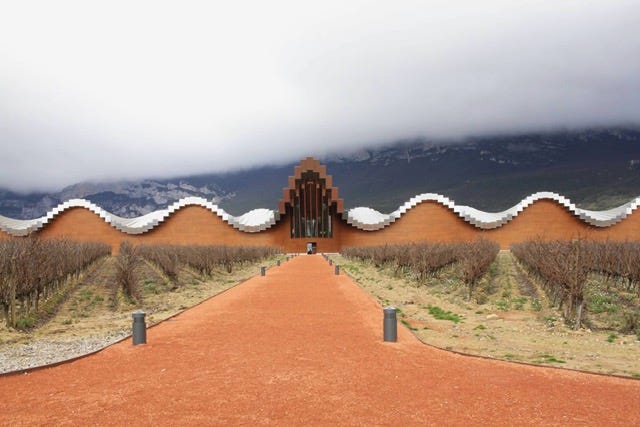
Wineries of the Week
When thinking of Rioja Alavesa a few big names come to mind including Marqués de Riscal, Bodegas Luis Cañas, and Bodegas Ysios. This week, I want to highlight a few of the lesser-known names making big impressions with small plots and old vines.
Bodegas Aiurri in Leza, Spain, sits in some of the higher elevations of Rioja Alavesa. Its historic vineyards consist of a collection of 60 small plots in the foothills of the Sierra del Toloño mountain range, each with unique clonal biodiversity, orientations, soils, altitudes, and microclimates. The female-led team at Bodegas Aiurri works each plot individually to showcase the unique character of the land. The grapes for Aiurri are grown between 500 and 600 meters above sea level in soils of loam and limestone. Here, the notable diurnal temperature shift helps to maintain the freshness of the grapes and wines. These diverse, small vineyard plots span 67 acres of bush vines aged 50 to 100 years and are farmed with ecological and sustainable viticulture practices to promote vine longevity. Primarily planted to various clones of Tempranillo, interspersed with Viura, Graciano, Garnacha, and other unidentified vines, the vineyards coexist with olive trees, oaks, and aromatic plants like lavender and rosemary to further balance the precious ecosystem.
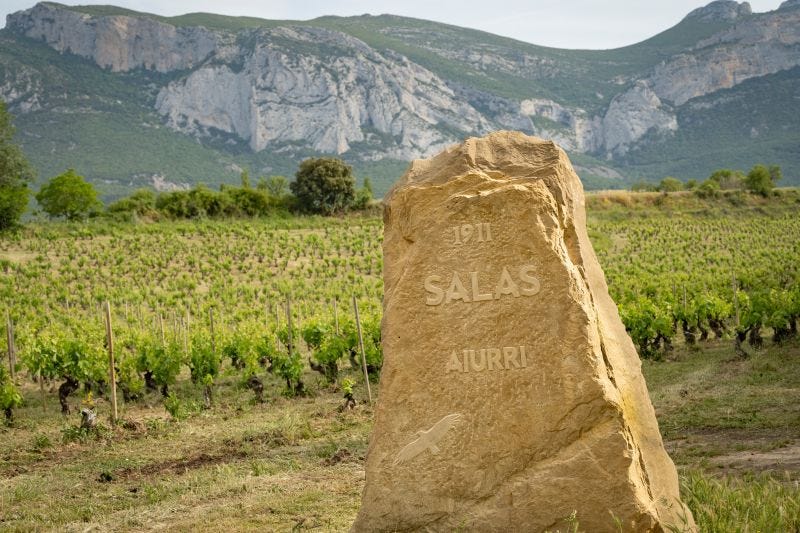
As for the wines, you’ll find three: Landua, Aiurri, and Salas. Each label is fermented with native yeast and only gentle extraction to preserve the unique terroir of the 60 small vineyard plots from which the wines are crafted. Landua is a reflection of the small plots of old vineyards between the municipalities of Sonsierra and Laguardia; Aiurri represents the character of Rioja Alavesa and the old vines that grow in the shelter of the Toloño mountain range; and the Salas is crafted from a 6.4-acre plot of 100-year-old vines with such clonal diversity, that there are multiple micro-plots within this small plot. Each wine is a unique encapsulation of place, time, and culture. And perhaps the village of Leza itself…
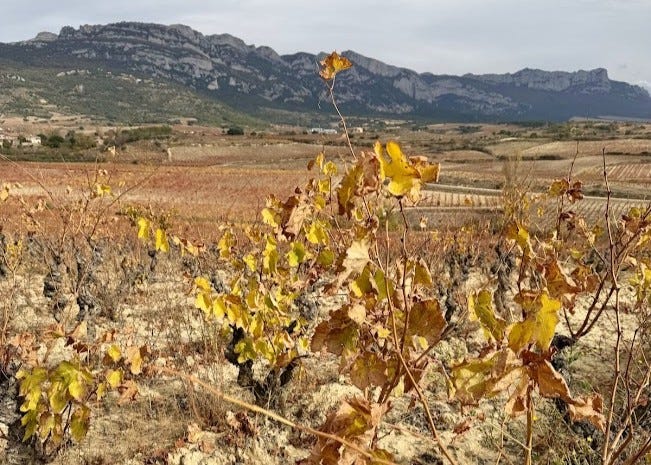
Making a case for village-level wines in Rioja? That’s exactly the aim of Bodega Bideona founded in 2018 in Rioja Alavesa as a joint-venture between the Izagirre family and Península Vinicultores. Bideona cultivates over 300 parcels of vineyards in the villages of Villabuena de Álava, Samaniego, Laguardia, Leza, Baños de Ebro, Navaridas, Lanciego and Elciego. The average vineyard size is around 0.75 acres and the average age is around 50 years old, with many parcels planted in the 1920s, 30s and 40s. Each plot is managed independently to contribute decisively to wines more expressive of origin versus method of production and aging.
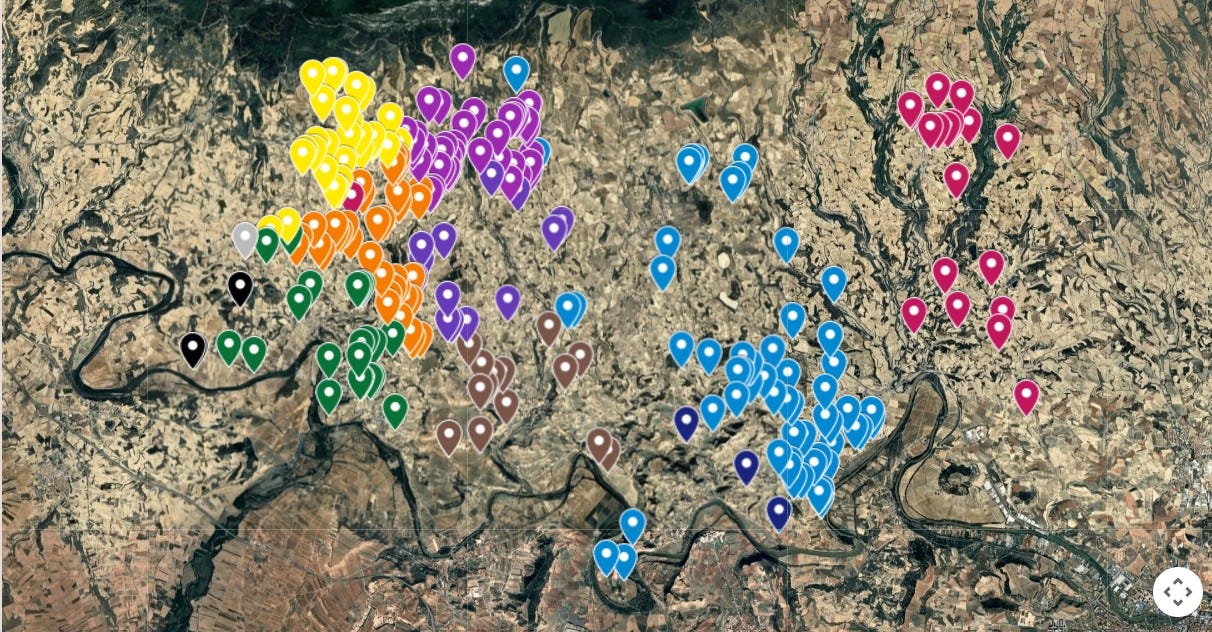
Bodega Bideona currently offers nine wines each intended to reflect their parcels, village, or region. The single parcel wines include Bideona Cofrades, a red wine from a 1.75 acre, ancient vineyard in Leza with a diversity of old massal selections including Tempranillo, Viura, Garnacha, Graciano, and Mencía, and Bideona Galtzada a red wine from a 1.1 acre vineyard of old vine Garnacha in Lanciego.
The village wines labeled creatively by letters and numbers**, include Bideona Laguardia (L4GD4), Bideona Villabuena (V1BN4), Bideona Samaniego (S4MG0), Bideona Leza (L3Z4), and Bideona Lanciego (LNCG0). Each wine is a field blend of Tempranillo made the same way to highlight the different characteristics resulting from each village’s clones, soils, position, and climate.
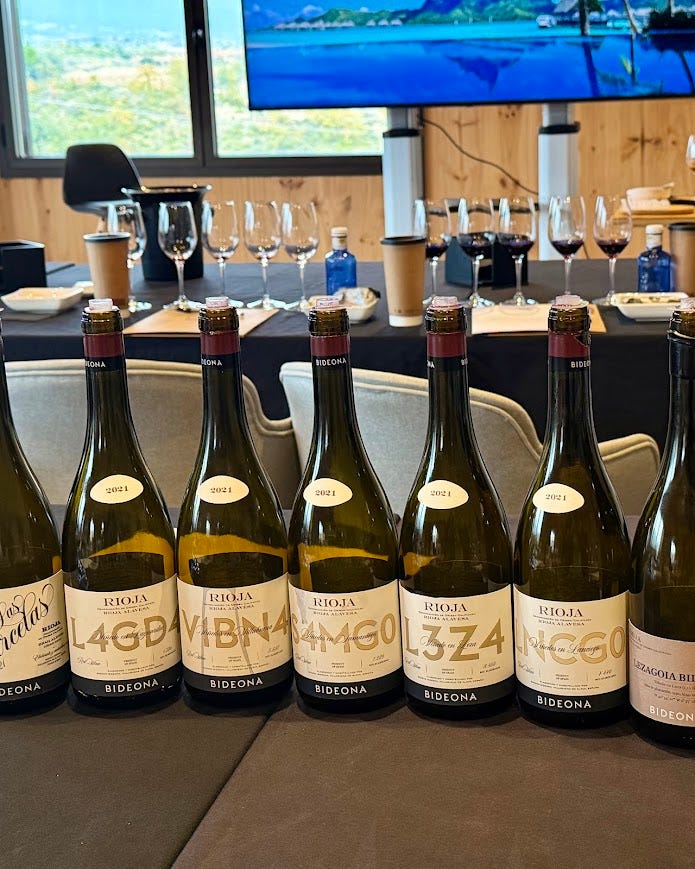
And as for the regional wines, Bideona Las Parcelas Blanco is a white blend with a majority of Viura. Las Parcelas Tinto is a red wine primarily of Tempranillo. Each is comprised of grapes from across Bideona’s 300 parcels.
**Under the DOCa Rioja regulations, there are three different classifications of origin: Viñedo Singular - single vineyard or parcel with a minimum vine age of 35 years and must be Rioja DOCa accredited for 10 years; Vinos de Pueblo - all grapes are exclusive to one village; and Vinos de Zona - the grapes are exclusively from one of Rioja’s 3 zones. While Bideona’s village wines would seemingly fall into the category of Vinos de Pueblo, the regulations require the winery’s physical location to also be in the same village as the vineyard from which the grapes are sourced. In other words, Bideona cannot use “Laguardia” on the label for their wine sourced from their Laguardia vineyards since the winery itself sits in Villabuena. Thus they named the wine “L4GD4.”
In My Mind
Bodega Bideona is still in its infancy (particularly for a Rioja winery), but the proof of their “origin vs production” philosophy is notable in the glass. Each village-level wine had unique qualities and characteristics. I personally would like to see a multi-vintage tasting of each of Bideona’s village wines to see if the characteristics remain consistent vintage after vintage, as well as to compare their Leza village wine next to Aiurri’s Salas, also from Leza. If there is consistency, I would definitely think they are on to something significant, which as a wine geek I can completely get behind. And I’m certainly up for the research.
That said, I do wonder if this push for a classification system that recognizes village labeling by vineyard vs. winery location will complicate the marketplace. It would essentially be similar to the Bourgogne-model of classification, which makes sense for the hundreds of parcels and dozens of villages with unique terroir across Rioja, but could also make it challenging or intimidating for the average wine enthusiast. I mean, hell, I’ve been studying wine for decades, and while Bourgogne has not been an area I’ve focused on heavily, I have studied it on numerous occasions, and I still get incredibly lost, and yes, definitely intimidated. And that’s with only 44 villages. Rioja has 144. That said, maybe the world is ready for a more nuanced version of Rioja. It is one of the most recognized regions globally, and it could create a new level of excitement and discovery. Wine Food for thought.
In The Room Where It Happened
Isn’t it wonderful to think, despite all of society’s incredible advances, that new discoveries are still possible out there in the wild? For me, it’s also one of the most rewarding aspects of wine. Whether it’s exploring new regions, varieties, or producers, or simply peeling back the layers of places previously delved into, the insights and revelations are never-ending. Such was the case on my most recent visit to Rioja, a region I’ve loved and studied for two decades and whose layers prove to be ever more numerous each time.
As students of wine we’re first taught about the main wine grape varieties. Then as we delve deeper into our studies, we learn that many of them are spontaneous crossings of other grapes, the most famous example being the crossing of Sauvignon Blanc and Cabernet Franc to create Cabernet Sauvignon. Well, in a recent visit to Bodegas Amaren in Rioja Alavesa, I learned that Tempranillo is also born of a natural and spontaneous crossing. In this case, a crossing of two native Spanish varieties, Albillo Mayor (a white grape) and Benedicto (a red grape). I’ll give Benedicto the attention it deserves below, but first I want to shine a light on the groundbreaking work happening at Amaren.
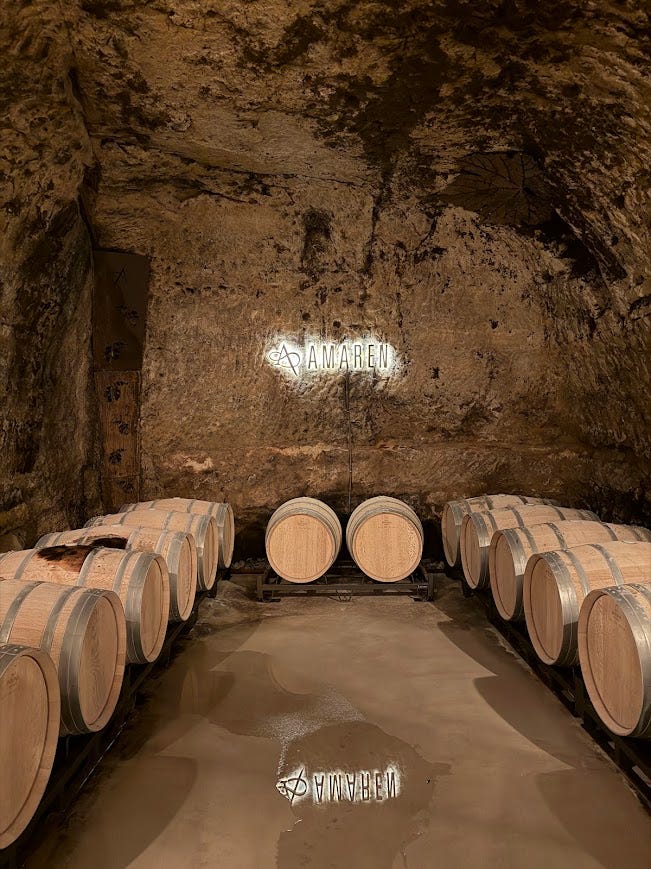
Bodegas Amaren, founded in 2016, was born from the Amaren label at Bodegas Luis Cañas. The label, Amaren Reserva Tempranillo, was named for Ángeles, the wife of Luis Cañas and mother of the winery’s next generation leader, Juan Luis Cañas. In 1995, Juan Luis set out to create a wine that expressed the personality of Tempranillo from several plots of old vineyards. At that time, his mother, who worked the vineyards alongside Luis and Juan Luis, passed. Amaren translates to “of the mother” in the Basque language, and the wine is a tribute to her role in the creation and development of the family winery. Eventually, Juan Luis opened the new winery, Bodegas Amaren in Rioja Alavesa, dedicated both to his late mother and to a style of wines more representative of place and vine, than aging and oak.
In recent years, the Cañas family, now led by Juan Luis and his son, Jon, began to take notice of the subtle differences in some of the old vines planted in their vineyards. Ever dedicated to the unique character of each vineyard, they teamed up with the Institute of Vine and Wine Sciences in Logroño to begin identifying each of the vines. In doing so, they discovered 37 vines of Benedicto as well as another 30 varieties and numerous clones that have been on their land for at least 100 years. They have since begun a recovery project of these vines and have planted over a hundred different biotypes of Tempranillo; dozens of variations of Graciano, Garnacha, Viura, and Malvasía de Rioja, among others.
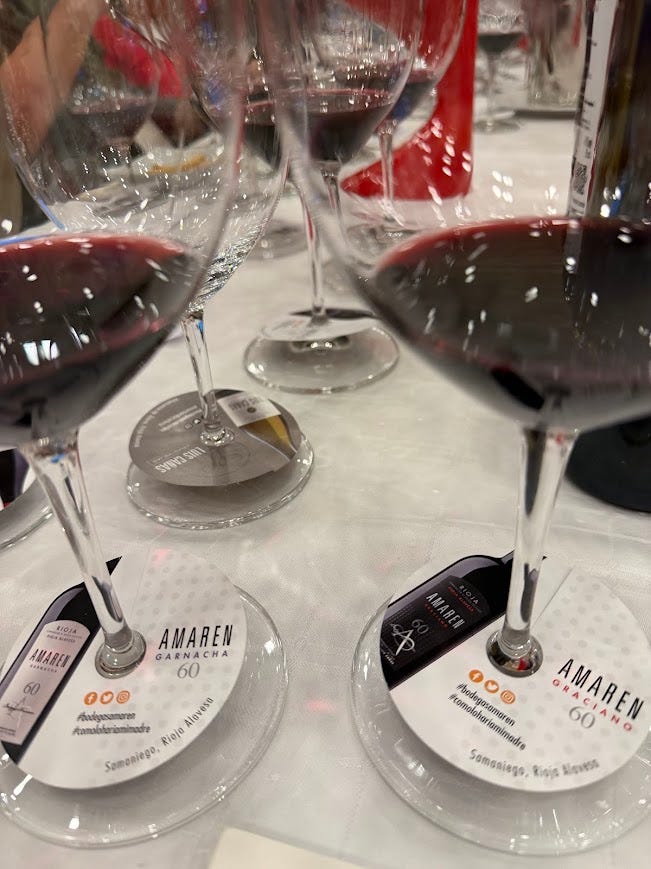
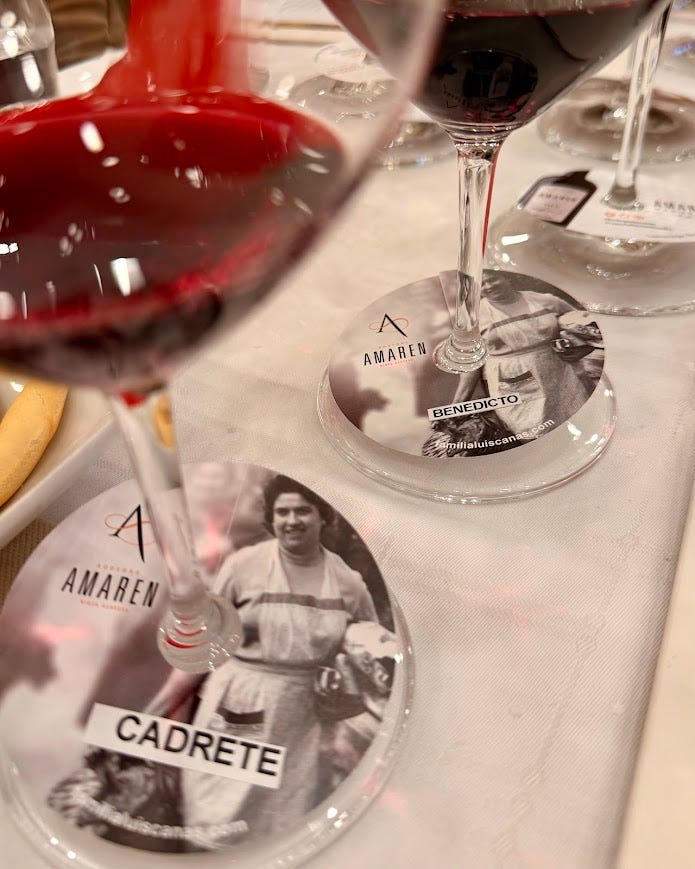
The Cañas family not only uses these varieties to add more nuance to their wines, but they also believe the various clones and species can potentially be used as a tool to manage climate change with some varieties having more natural resistance to drought and heat. And while many of the old vines don’t produce much fruit, they are also experimenting with the various varieties through small batch and micro-vinifications, even bottling a few for limited production releases. And yes, a few of these newly rediscovered varieties, including Benedicto and Cadrete can be tasted at Bodegas Amaren! It’s proof that vineyards still hold secrets, even in regions as studied as Rioja.
In Good Conscience
Trees are vital to our shared environment. They pull carbon dioxide from the air, while producing the oxygen vital to our existence. In fact, according to the Arbor Day Foundation, a large tree will absorb more than 48 pounds of carbon dioxide in one year and can provide oxygen for up to four people daily. These natural wonders also transpire the water they take in from their roots, putting it back into the atmosphere, which ultimately forms clouds, rain, and snow.
In a 2020 study by Spain’s Basque Government, it was determined that the amount of greenhouse gasses released each year in the Basque Country can reach up to 18.9 million metric tons, while 10% of those emissions are absorbed by forests and crops. Recognizing the significance of trees to the local environment, the aforementioned Cañas family behind Bodegas Amaren and Luis Cañas, began planting new trees in their vineyards. They also extended the initiative to the 40+ vineyard families from which they source grapes. It’s estimated that within a few years, these newly planted trees will be capable of absorbing 6,500 kg of CO2, which equates to the total emissions of 65 car trips between the border of Northern California and Mexico. In other words, it’s not nothing for our mother Earth, especially as these trees will also enhance the vistas, lend biological diversity to the region, shelter local wildlife, provide fruit, and lend vital shade for the growers working the vines. And I might add, it also adds a bit of a celestial and dual meaning to their Basque name, Amaren.
In Depth
Rather than dive into one grape variety this week, let’s take a look at the 14 approved varieties for DOCa Rioja. Unsurprisingly, of the 165,000 acres of vines, Tempranillo makes up 88% of the plantings. And of course, you’re going to find that other wildly popular red Spanish variety of Garnacha. But there are a few more reds you might not know:
Graciano - an often favorite single-varietal wine of mine (if well-crafted), is widespread and boasts a long history in Rioja. It makes up only about 2.5% of plantings in the region, but it is known to be drought resistant and friendly in a blend adding aging potential with its tannins and acidity. On its own, it often has a deep color with notes of crushed cherries, herbs, and minerality.
Mazuelo - also makes up roughly 2% of plantings in Rioja and is often used in blends for its acidity and tannins. It too showcases red fruits, herbs, and spice.
Maturana Tinta - a variety I’m most excited about as it is becoming more common as a single-varietal wine. It is a delicious descendent of Cabernet Franc. Maturana Tinta has an intense color and tannins, and as you might suspect, is notably herbaceous. Keep your eyes out for this one!
Before we move onto the white grapes of Rioja, let’s quickly chat about the recently discovered (although technically not approved variety) of Benedicto. Benedicto, which we now know is a parent of Tempranillo with Albillo Mayor, was long thought to be extinct. The recent findings in Rioja Alavesa have shown that this native grape produces a solid quality wine with high aromatic potential. It’s structured, but with notable balance, juicy acidity, and fine tannins. And it definitely does not lack for freshness. It’s also proving to be a suitable variety to stand-up to climate change.
Now, let’s turn our attention to the all too overlooked side of Rioja, the white wines, of which there are nine varieties. In other words, it’s definitely not all the oxidative, oaked style of Viura many of us first encounter when seeking a White Rioja (looking at you, with utter love and devotion, López de Heredia).
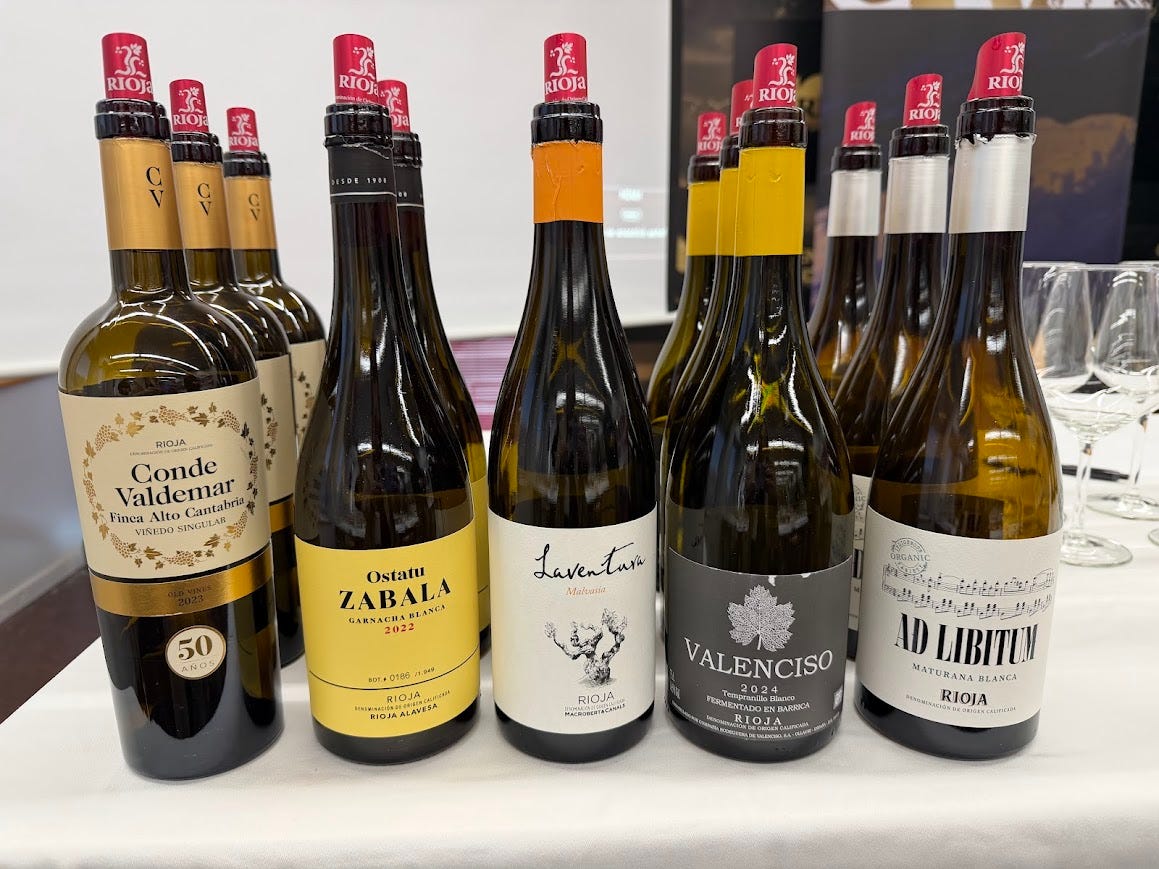
Viura (aka Macabeo) is the most widely planted white grape accounting for 66% of plantings. It spans a range of styles from fresh and crisp to more complex and brooding with flavors of green apple, white flowers, and almonds. Among the other white grapes, you’ll encounter the typical international varieties, including Chardonnay and Sauvignon Blanc, alongside well-known Spanish grapes like Verdejo and Garnacha Blanca. And as for those lesser-known white grape stars, they include:
Tempranillo Blanco — not made from red grapes, but a white mutation of Tempranillo discovered in 1988 and found only here. Aromatic, with floral, citrus, and tropical notes, and refreshing acidity.
Malvasía de Rioja — one of Rioja’s oldest whites, not related to the Malvasía family. Fuller-bodied, creamy, and highly aromatic, with stone fruit and floral notes.
Maturana Blanca — the most historic variety, showing apple, banana, citrus, and subtle herbaceous undertones.
Turruntés (Albillo Mayor) — unrelated to Torrontés from Galicia or Argentina. It’s light on the palate, with bright acidity, gentle bitterness, and orchard fruit, vegetal, and herbaceous notes. And it’s half of the parentage for Tempranillo!
While these whites are going to be found mostly in blends, as a category, white Rioja now makes up 12% of Rioja’s overall sales. Not only that, Rioja is now the 2nd largest white wine producing region - even ahead of Rías Baixas. These crisp quaffers are easily changing how people drink Rioja, and I think you’ll soon see them taking more deserved space on wine lists. I, for one, am ready for that!
In Brief
While we’re on the topic of interesting grape discoveries, a few years ago on a trip to the Navarra region of Spain I had the opportunity to visit the Estación de Viticultura y Enología de Navarra, EVENA, in the town of Olite. EVENA is a government organization specializing in education and exploration.


The research station has its own greenhouses where they cultivate various ancient vines, as well as an experimental vineyard and winery. The group conducts research and experiments, and serves as a resource to local growers by offering technical advice on the subjects of viticulture and oenology. Some projects have included old vine identification and cultivation, the history of Garnacha, carbon capture in soils, sulfite-free winemaking, and growing strategies for climate change. The studies I found most interesting was that of the ancient vines.
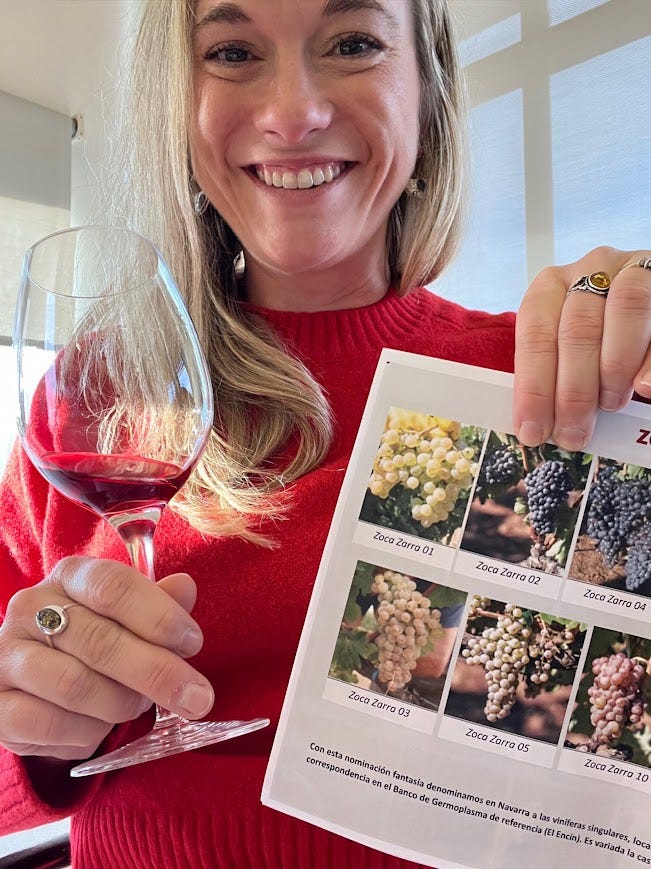
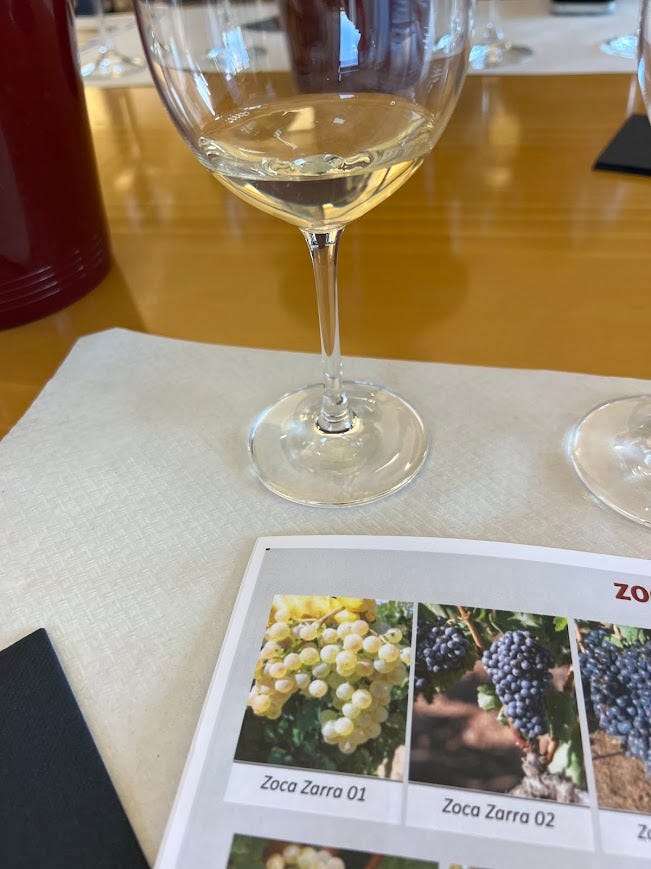
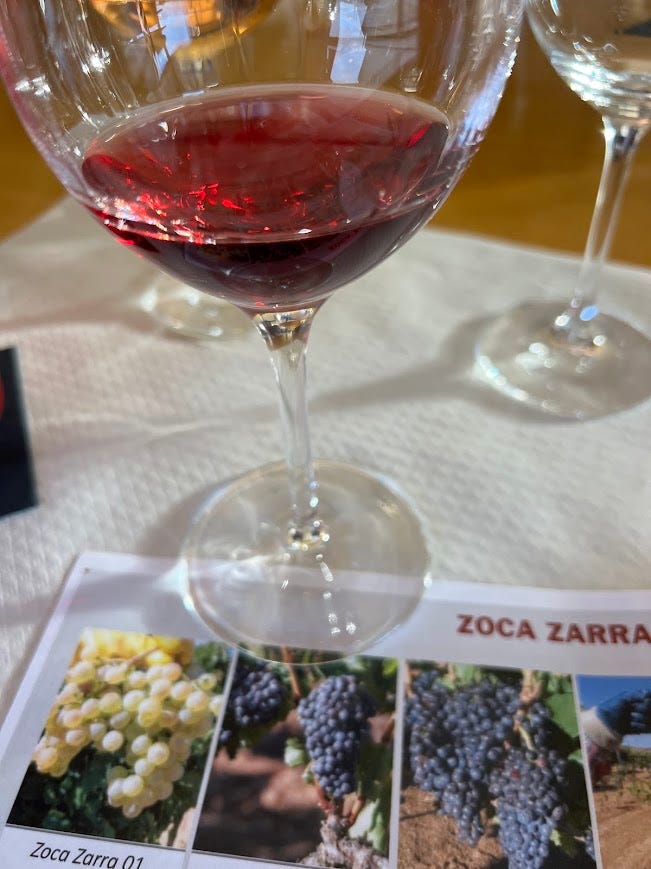
The researchers at EVENA have discovered 10 completely unidentifiable grape varieties in the area’s ancient vineyards. They refer to these 10 mystery grapes collectively as the Zoca Zarras. Currently, EVENA has put forth four of the 10 Zoca Zarras, which they believe to be viable as wine grapes, for inclusion in the Register of Commercial Varieties.
In Living Color
If you’re new to Rioja, or even just a general enthusiast of the region, the town of Haro is one of the easiest places to begin your regional travels and explorations. Located at the heart of the Rioja Alta zone, Haro is home to the legendary Barrio de la Estación, the greatest concentration of century-old wineries in the world. Some of Rioja’s most iconic producers are based here, and even after several visits, I still discover something new each time.
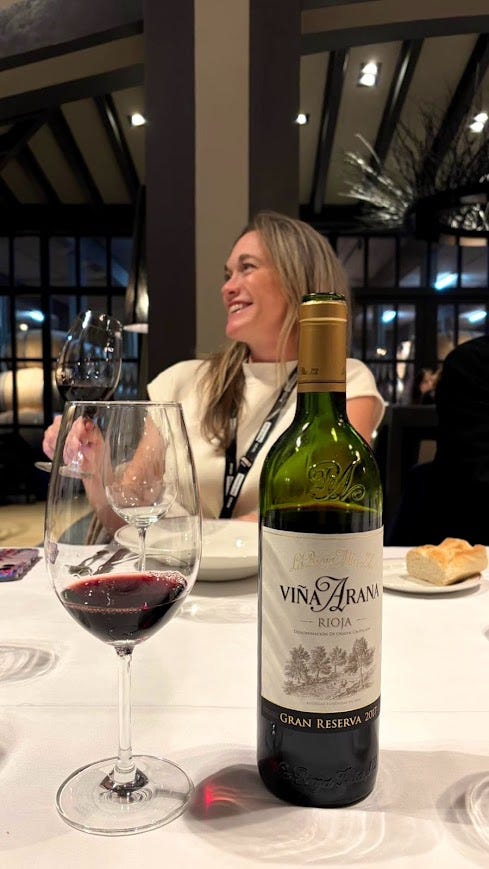
The Haro train station, built in 1863, quickly became a vital artery for transporting Spanish wine, as well as French winemakers into Rioja when phylloxera devastated French vineyards. With the French came new techniques, most notably an emphasis on barrel aging. When many of the French eventually returned home, Basque families stepped in, blending that French precision with Spanish tradition. This is when the legacy emerged. The first of the wineries established in the Barrio was R. López de Heredia y Landeta in 1877. In 1879, two brothers from Bilbao founded the Compañía Vinícola del Norte de España, more commonly known as CVNE. Three more wineries followed in relatively short order: A. y J. Gómez Cruzado (1886), La Rioja Alta S.A. (1890), and Bodegas Bilbaínas (1901). Eventually, in 1970, Bodegas Muga (1932) moved its headquarters to the Barrio, and in 1987, Bodegas Roda became the last winery established in the Barrio. Today, the Barrio de La Estación offers wine tours, a “Passport” experience, and every two years they host a fast-selling festival at which all six wineries open their doors to ticket holders and offer two wines and a variety of tapas.


(Special note: R. López de Heredia, although a founding member of the Barrio, no longer participates in its tourism programs.)
In Context
Rioja is not all big name producers with thousands of barrels and millions of bottles. Like any region, there are plentiful producers spanning from the large and globally recognized to the micro and relatively unknown. In recent years, a group of those small wineries formed Menudas Bodegas, a collective to help raise not only their individual profiles, but their shared mindset. Scattered across Rioja, these artisanal wineries share a set of simple philosophies:
The vineyard and cellar center around one person - a vigneron who both grows the grapes and makes the wine.
Production is tiny. Generally fewer than 10,000 bottles per winery (roughly less than 1,000 cases/year).
Quality isn’t scaled here. It’s handcrafted, driven by detail, devotion, and the steady hand of the grower for a pure expression of site, season, and soul.
As part of my experience at Rioja Camp, I was able to meet two Menudas Bodegas near Haro and both in Rioja Alta: Elena Corzana and Bodegas Óscar Pérez. The two vignerons shared their limited production wines inside the Pérez family’s 200-year-old underground cellar in the medieval village of Briones (a historic town worth a visit if you’re in the region).


Óscar Pérez produces just two wines: “Zaruga Blanco” a white Rioja of Viura and Garnacha Blanca and “Zaruga Tinto,” a Tempranillo, Garnacha, and Mazuelo. This is a small family project with heart, history, and a desire to communicate them both through wine. And they are open by appointment for tours as well.
Elena Corzana crafts four wines from her family vineyard in Navarrete: Maturana Tinta, Graciano, Maturana Blanca, and “Lane Greta,” a Tempranillo made in collaboration with her cousin, Sandra Corzana. Like Óscar, Elena grew up in Rioja where her family has long ties to viticulture. After spending 20 years making wine around the world, she returned home to begin her own label with wines distinctly reflective of her home village of Navarrete.

If you want a more complete picture of DOCa Rioja when you visit Haro (or another part of Rioja), plan to seek out a few Menudas Bodegas as part of the adventure. They are as equal a part of Rioja’s authentic soul as the big names you already know and worth discovering.
In the Know
Here are a couple of extra details about DOCa Rioja and Haro that you might not know:
Bodegas Bilbaínas has produced a sparkling wine since its inception in 1901. It is named “Lumen” for the electric lights that were used in Haro - one of only two Spanish towns with electricity at the time. The other was Jerez.
Gómez Cruzado, founded in 1886, is considered the “boutique” winery of Haro’s Barrio with only a 240,000 bottle production. By contrast, CVNE produces between 7 to 8 million bottles.
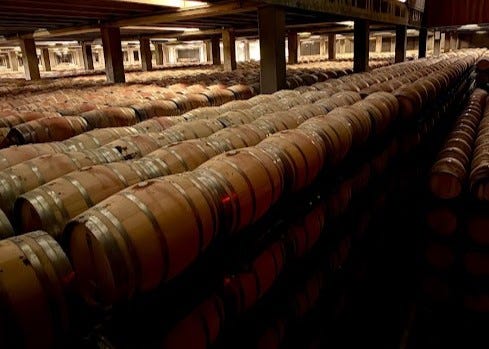
Sixty-six percent of wines in the DOCa Rioja are barrel aged. There are approximately 329 “aging wineries,” home to around 1,330,000 225-liter oak barrels containing more than 400 million liters of wine.
In the News
Excited to share the news: I am now a Certified Rioja Wine Educator. (If this Substack isn’t evidence enough - ha!) As a wine writer, educator, consultant, and communicator with a long-standing focus on Spanish wine, Rioja represents both a professional cornerstone and a personal source of inspiration.

Spain was the country that first ignited my passion for wine, and Rioja remains one of the regions that continues to shape my curiosity and ambitions. It is an honor to have taken part in this program and to now be able to better contribute my voice, experience, and enthusiasm about this beautiful Spanish region.
In Production
The most downloaded guide I produced here in the last few years was easily my Willamette Valley Guide published in the fall of 2024. I’ve also received many emails and DMs from travelers requesting it, as well as from those that discovered something new as a result of using it for their trip planning or wine shopping. Well, since the publishing of the guide, I have likely visited dozens more wineries across the Valley, and I have certainly tasted hundreds more local wines. So, I think it’s time for an updated version. Stay-tuned. I’m hoping to drop my 2026 Willamette Valley Guide with new lists, new categories, and a few other surprises.
In the Hopper
Aside from the aforementioned WV Guide, I’ve just returned from a short trip to the Southwest and will have a few things to share from one of Arizona’s three American Viticultural Areas. And then it’s time to set off again for a trip that won’t be centered on wine, but will certainly include it. The region? Japan! I won’t be visiting the wine production areas on this visit, but with more than 350 wineries and several unique grape varieties in production, you know I’ll be “researching.”
I've been all over Spain except Rioja. If I go one day, this series will be my reference