As did I, walked into a bar that is, and here are a few of my finds, plus a favorite from this month’s adventures in Puglia.
In My Glass
I’ve revisited this wine a few times now. It’s not often I see a white wine from Saumur (best known for my beloved Cabernet Franc) on a by the glass list, let alone on a retail shelf. This 100-percent Chenin Blanc is native fermented and bottled unfined and unfiltered. In other words, the grapes from the chalky limestone hillsides of Brézé get to do a lot of the talking here - and I’m all ears. This wine is nervy, flinty, and mineral-driven with a racy backbone of citrus and orchard fruits. It’s viscous and saline, and seriously makes you wonder why we don’t see more of this on the market. Cuz, you will want more. Alluring. $33
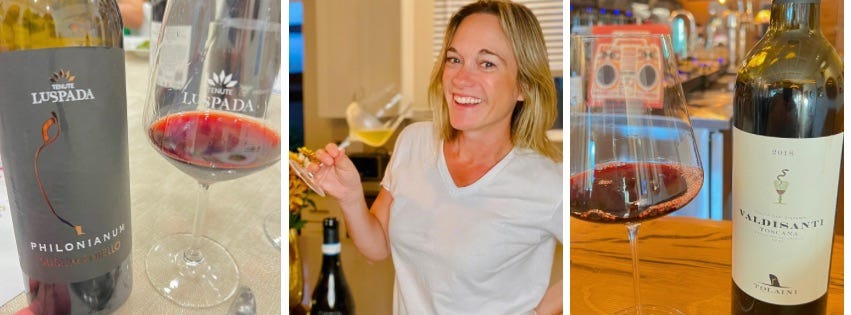
2021 Tenute Lu Spada Salento Susumaniello Philonianum
Suitcase wine alert! This is one of the five bottles I carefully wrapped in wine sleeves and clothes and tucked away in my bag. In fact, it was my favorite wine from Brindisi winery, Lu Spada. Susumaniello is a rare grape found in Puglia that produces both red and rosé wines with notes of red berries, plums, spice, and sometimes, pepper. It can range from fresh and medium-bodied to more rich and full-bodied styles. The Philonianum, whose namesake was a wine produced in amporae in Brindisi in 19 BC, leans more towards the fresh, austere style with its juicy, red-fruits, electric acidity, and its moderate and well-balanced alcohol (only 13%). Served at a dinner among several other wines, it’s the one I kept going back to and will again soon. On repeat. $20
2018 Tolaini Valdisanti Tenuta San Giovanni Toscana
A blend of Cabernet Sauvignon and Cabernet Franc, the aromas of this wine are everything I love about Cab Franc in Tuscany with its herbs, graphite, and fresh berries. The palate, however, is far more dominated by the Cab Sauv with bold black fruits and an herbal overlay. It’s a solid blend, friendly and feisty, and one that will warm you from the inside out. And as it’s not a shy guy, it totally begs for an equally warming, comforting dinner. Basically, it’s the wine embodiment of my former Italian-American neighbors in Chicago - and likely a wine they would have opened while serving up home cooked dishes on a rainy Friday night. Like family. $46
In the Spotlight
Winery of the Week
Torre a Cona sits about 10km from Chianti Classico in the lesser known region of Chianti Colli Fiorentini, which immediately borders Florence. The 18th century villa, and numerous Tuscan farmhouses, is surrounded by olive groves and three isolated vineyards that have been a part of the family for 80 years. The estate, which dates back to 1066, was purchased by Napoleone Rossi di Montelera, third generation ownership of Martini & Rossi in 1935.
During the World War II, the villa transitioned from German military occupation to a British hospital. During that time, the family stored works of art by Michelangelo and Donatello, among many other Renaissance artifacts in the cellars. Knowledge of these tucked away treasures, spared the estate from bombings. The family resumed life at the villa after the war, beginning its restoration, modernizing and improving the vineyards, and operating small family wine projects. However, it wasn’t until after the family sold Martini & Rossi to Bacardi in 1993, that the most recent generation began to contemplate commercial wine production and tourism at Torre a Cona. And they did just that, 25 years ago.
Today, Torre e Cona manages 47 acres of vineyards situated in various positions across their sprawling estate with elevations ranging from 300 to 410 meters above sea level in soils of clay, sandstone, Galestro, a metamorphic clay-schist. The family grows a variety of grapes including Sangiovese, Colorino, Merlot, Trebbiano Toscano, and Malvasia Bianca. And it was just this month, that Torre a Cona was named the recipient of Gambero Rosso’s 2025 Tre Bicchieri Red Wine of the Year for its Molino degli Innocenti Riserva 2019, a 100-percent Sangiovese. This particular wine came from the 400-meter Molino degli Innocenti vineyard. After several experimental harvests, followed by small lot production to understand the potential of this particular parcel, the wine was first released this year.
The family produces numerous labels from their various vineyards including single-varietal wines, blends, and the dessert-style for the region, Vin Santo. And as previously mentioned, they have also dedicated themselves to wine tourism, to share the beauty, history, and timelessness of the estate with visitors. Torre a Cona offers room and apartment rentals, an osteria (open March to November), and a variety of experiences from wine tasting and truffle hunting, to horseback riding and cooking classes.
Wines to note: 2019 Molino degli Innocenti Chianti Colli Fiorentini Riserva DOCG and the Badia a Corte Chianti Colli Fiorentini Riserva DOCG label (particularly the 2012 and 2016)
Wine Region(s) of the Week
A bit further south and east of Chianti is the region of Puglia in Italy. Puglia is a significant region for wine (and olive oil) owing to the climate and fertile soils. It encompasses around 7,500 square miles and represents the entire heel of the boot, plus a bit further north into the “spur,” which is the only part of the area that isn’t flat. Within Puglia, you’ll find more than 30 Denominazione di origine controllatas (DOCs), four Denominazione di Origine Controllata e Garantitas (DOCGs), and six Indicazione Geografica Tipica (IGTs).
Puglia is a vast and fascinating wine region whose history in winemaking was primarily for the bulk market. In fact, many of the first established wineries are within the city limits, often directly adjacent to the train stations, where much of the wine was shipped to northern Italy and France. And if you catch a glimpse inside those wineries, you’ll find massive cement tanks once used to hold gallons upon gallons of wine. Today many of those cavernous tanks have been converted to tasting rooms, barrel cellars, museums, or in one case, even a fully function restroom!


So, as you can ascertain, the name of the game was once quantity for Puglia, but as is the case in many once bulk producing regions, there has been a significant shift towards quality, elegance, innovation, and sustainability. Today, Puglia is generally divided into three main viticultural areas: Foggia in the north, Bari and Taranto in the middle, and Brindisi and Lecce in the south. And with the exception of the northern region, Puglia is extraordinarily flat. It’s also fertile and noticeably fragrant from the marine salinity that sits in the air, to the fragrant Mediterranean scrub, locally referred to as “la macchia.” It’s a region steeped with biodiversity. But for this spotlight, let’s hone in on the two most recognized DOCs from which I just returned (you can read up on the third I visited, Brindisi, here).
First up is Primitivo di Manduria, which was established as a DOC in 1974. This coastal region with 18 municipalities runs 25 miles north to south along the Gulf of Taranto and east from the coast to Brindisi. Primitivo di Manduria is characterized by hot, dry summers with very little rainful, and constant sea breezes. Today there are approximately 7,600 acres of vineyards, planted in both bush vines and with traditional vertical shoot positioned trellising in iron-rich and calcareous soils. The 100, or so, wineries range from small family operations to larger co-ops.
The region takes its name from both the most commonly grown red grape, Primitivo, and the town of Manduria, from whose railway station used to take tankers of bulk wine throughout Europe. The Primitivo grape is dark-skinned and inky, and produces lush, tannic wines with intense flavor and color. Primitivo di Manduria, specifically, tends to express greater strength, richness, and character with a variety of aromatics and flavors from fruit and spice, to herbs and earth. And many producers in the region have committed to reducing yields and using modern techniques to make higher quality wines with greater complexity. In other words, while Primitivo, like its USA counterpart Zinfandel, is often thought to be jammy, fruit-forward, and high in alcohol, today’s Primitivo ranges in style from those big, bold fruit bombs, to more fresh, balanced, and nuanced expressions.
Producers of note: Cantine San Marzano, Cantina Produttori di Manduria, Varvaglione, Antico Palmento, and Masseria Altemura
Now, let’s jump over to the second most recognized DOC in Puglia, Salice Salentino, established in 1976. Salice Salentino is centrally located in Italy’s heel between the Adriatic and Ionian Seas, which are literally just kilometers in either direction. The region is known for, and based on, the Negroamaro and Malvasia Nera red wines (but the white wine, Verdeca, is a hidden gem). The soils here are predominantly composed of clay and limestone, which helps retain moisture during Puglia’s hot, dry summers. The climate, of course, is Mediterranean, with long, hot summers and mild winters with the nearby seas providing cooling breezes that mitigate extreme heat and allow the grapes to ripen while preserving acidity. As for the dominant grape, Negroamaro, it has notable but approachable structure, freshness, and savory undertones. And it does well in sparkling, white, rosé, red, and even dessert style wines. Talk about a jack of all trades!
Producers of note: Masseria Li Veli, Cantina Moros, Leone De Castris, Castello Monaci, Cantina San Donaci Anticaia, and Apollonio Casa Vinicola
In the Moment
A few weeks ago I had the opportunity to capture a brief, exclusive interview with Niccolò Rossi di Montelera of the aforementioned Torre a Cona, the Gambero Rosso Red Wine of the Year recipient for 2025. During the vertical tasting shared ahead of the awards with the international press crew, Mr. Rossi was obviously moved by the award and the experience. Despite the family’s lengthy history in both wine and vermouth, this was not a moment taken for granted. You could see the humble honor and gratitude in his eyes and hear it in his inflection - particularly when he talked about his family. So in the spirit of this new series of spontaneous, live videos, completed in one take, and under three minutes, I posed a few questions based on that spark I caught in Mr. Rossi’s eyes that afternoon, and that I also felt in each of the wines.
As for the vineyard we briefly discuss, it’s the source of the family’s inaugural 2019 Molino degli Innocenti Chianti Colli Fiorentini DOCG. The highest elevation vineyard on the estate, Mr. Rossi’s father never thought the site would produce a fine red wine owing to the very cool climate and its historic inability to full ripen grapes. However, owing to climate change and numerous research trials, the site is now warmer and capable of ripening the grapes and the family has ascertained how to best showcase the fruit. Furthermore, the family and the vineyard can now lay claim to being the home of the Tre Bicchieri Red Wine of the Year 2025.
In the Press
“Putting Their Palates to the Test” by Deborah Grossman ran this week in the Pleasanton Weekly, covering the Luxury Somm Dinner in Livermore, California last week. It captures thoughts and takeaways from the four sommeliers who participated in the various events throughout the Taste weekend. For my part, I was mostly quoted correctly with a few exceptions, one being, as much as I love Cab Franc and jumping in as I can at harvest (as I did last week at Steven Kent winery below), I have no intention to work a full Cab Franc harvest next year. Been there, done that, and unless it’s for my own label one day, those special harvest days are past.
In the Know
In one of the more bizarre conversations I’ve found myself in recently (and I often find myself in bizarre conversations - I’m a good listener), I came to learn that white wine can apparently help protect people from food poisoning and foodborne illnesses, such as E. coli. How did I discover this interesting fact?
Well, like all good stories it starts with: A man walked into a bar. I happened to be sitting at said bar as he asked the bartender (and beverage manager of the wine bar), “Do you have any white wine?” The bartender, looked back somewhat quizzically, and said he had several. He then asked if the man was looking for anything in particular to which he then responded, “I don’t really know. I don’t drink wine. So any white wine is great. Have you tried any of these?” (Again, there were quizzical, but kind, looks.)
Now, being that we’re in a wine bar, this is quite an odd conversation to begin with, but then he looks between me and the bartender and says, “This is going to sound crazy, but I was just at McDonald’s eating a Quarter Pounder, and the guy working there says he’s not even sure why they’re serving these after McD’s announced an E. coli scare today. So, I looked up how to prevent E. coli and Google said, white wine. So here I am. I just need some white wine.”
The bartender gave him a glass of Arneis with a brief description after which the man all but chugged the glass before ordering another. He took more time with the second glass proclaiming he actually kind of liked it, and that maybe he could get into wine. After that he asked me a lot of random questions about wine before vowing to for sure come back - because he really could get into wine. After he left, the bartender and I exchanged shrugs and I immediately set out researching white wine and E. coli. And, well, wouldn’t you know it, this is what I found from the October 2002 issue of Decanter:
“Microbiologists Mark Daeschel and Jessica Just at Oregon State University discovered that wine – and especially white wine – inactivated virulent bugs (called pathogens) like E.coli (pictured) and salmonella, staphylococcus and klebsiella.”
The article goes on to explain that it’s not the alcohol in the wine that kills the bacteria, but rather the acid, “They found it is the malic and tartaric acid that kill bacteria, rather than anything present in the alcohol. Because white wines have more acid then red, they are more efficient at killing bacteria, Daeschel said. ‘People who drink wine with meals may protect themselves from food poisoning,’ the ASM journal says.”
I guess we can put that in the column for wine is still good for you. And I hope it worked for our “man that walked into the bar.”


I'm always learning something here! White wine can help with E. coli, who knew???
Also I find it interesting this wine bar had Arneis! Was that in Livermore? I just had some in Italy and loved it!!